Confrontation
The building of The Community no longer sleeps. Behind closed stone doors, fear stirs before understanding does.
I do not see Tariro, but I know where she is. The women’s dormitories lie on the opposite side of the structure, and I imagine her moving from mat to mat, shaking shoulders gently but firmly, forcing wakefulness into bodies that would rather cling to exhaustion. Her voice carries faintly through corridors and stone, not loud, but urgent enough to fracture dreams.
“Get up. You must leave.”
A pause, then steadier.
“There is a rebellion in Gungara. The city will flood. If you stay, you will die.”
Questions must arise immediately. Confusion, disbelief, fear pressed tight behind ribs. But Tariro does not linger. She has learned that panic feeds on hesitation. She repeats herself, points toward exits, and urges movement. She does not stay long enough to be argued with.
I turn away from the sound of her voice and move toward the men’s dormitories.
The door resists when I push it open. Inside, the air is heavy with sweat and stone dust. Several men are already sitting up, startled by the noise, eyes sharp with suspicion, the moment they see me. A woman. Armed. Standing in a place that was never meant for me.
“What is this?” one of them asks.
“Who are you supposed to be?”
“There is no time,” I say, and my voice sounds colder than I expect. “You need to leave the city immediately.”
Murmurs ripple across the room. Some laugh, short and dismissive. Others watch me with narrowed eyes.
“A woman comes in the middle of the night,” another says, “talking about floods and rebellion. You expect us to obey?”
I step fully inside, letting the torchlight catch the dried blood on my torn clothes. I do not raise my voice, but I let it harden.
“Yes,” I answer. “I do.”
Their hesitation thickens. Pride wars with fear. I recognize the moment. I have seen it before on training grounds, in villages, in eyes that refuse to accept danger until it stands too close to ignore.
“The barrages around Gungara are being destroyed,” I continue. “The river will return to its path. If you stay, you will drown or be buried under stone. If you leave now, you might live.”
“And why should we believe you?” someone snaps.
I meet his gaze without blinking. “Because assassins from The Community came for me tonight,” I say. “And failed.”
That stops them.
“You know what The Community does to those it fears,” I add. “If you doubt me, stay. But do not stop those who wish to live.”
Fear finally cracks through stubbornness. Movements explode at once. Men scramble for cloaks, boots, anything they can carry. I step aside and let them rush past me, faces tight with urgency, disbelief dissolving into survival.
When the last of them is gone, the dormitory feels emptied not just of people, but of purpose.
I leave it behind and return to the central hall.
Tariro is already there.
The vast space feels hollow now, torches flickering against columns carved with symbols meant to inspire obedience. At the far end stands the sun-carved wall, its central seam still almost invisible unless one knows to look for it.
We do not speak at first. There is no need.
I walk toward the wall and draw the key from where it hangs against my chest. The metal feels heavier than before, warm, as if it remembers what it unlocks. I fit it into the carved sun. For a heartbeat, nothing happens.
Then the stone shudders.
The wall splits along its hidden seam, grinding open with a sound like restrained thunder. Dust falls. Cold air breathes out from the darkness beyond. A narrow corridor reveals itself, long sealed, long waiting.
I step back toward Tariro and hold her gaze. The weight of what comes next presses hard against my ribs.
“Tariro,” I say quietly, but there is no softness in the command beneath it. “The moment you see that I can get out of this alone, or the moment you are in danger, you leave. As we agreed.”
She does not argue. She simply nods.
“I refuse to lose you,” I add. “You know that.”
“I know,” she answers.
Together, we turn toward the hidden corridor of The Community, certain that Masimba is no longer far ahead of us.
The corridor ends without warning, opening into a vast chamber sealed on all sides by smooth stone walls. The air inside feels different, heavy and deliberate, as if the room itself is aware of being watched. Four large braziers burn at each corner, their flames steady and controlled, casting slow-moving shadows that never quite touch the center. The light reveals a space designed not for defense, but for authority.
Masimba sits at the far end, relaxed in a wide stone chair carved directly from the floor, his posture almost careless. He does not rise when we enter. He only watches. Two assassins stand several steps before him, shields raised, spears angled toward us. Their stance is ready, disciplined, familiar in a way that immediately tightens something inside my chest.
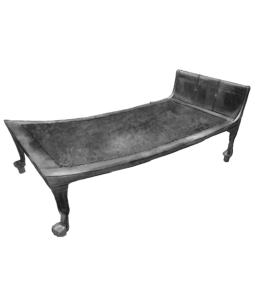
To Masimba’s left, half lost in shadow, stands a bed unlike anything I have ever seen. Its surface curves gently, the raised cushioned backrest shaped for comfort rather than restraint. The frame appears to be crafted from richly grained hardwood, polished to a soft glow that catches the firelight. It rests on carved, elegant legs. Upon it lies the silhouette of a woman. She does not move. Her breathing is slow, peaceful, untouched by the tension thickening the air. She looks less like someone asleep and more like a statue placed there to be admired, protected from time itself.
There is no time to wonder.
The assassins move the moment Tariro and I step fully inside. We split instinctively, each of us meeting one without a word exchanged. My feet slide across the stone as I lower my spear and drive forward. The first clash rings sharp and metallic, spear against shield, force answering force. He is strong and trained, but his movements are rigid, almost predictable. I pivot, using his weight against him, strike low, then lower still. My spearhead sinks into his foot, pinning him in place with a cry of pain he does not have time to finish. I do not hesitate. I slam the shaft of my spear against the edge of his shield and drive it upward into his neck. There is a sharp crack, wet and final. His body goes slack before it hits the floor.
I am already moving.
Masimba rises at last, smoothly, as if he has been waiting for this moment. He reaches to his left and draws a sword of remarkable craftsmanship, its blade etched with fine patterns that seem to catch the firelight and bend it. To his right, he takes up a shield just as finely adorned, polished, and unmarred. He does not rush me. He smiles.
Behind me, steel clashes again. I hear Tariro’s voice, raised, urgent, threaded with something raw and familiar. Words overlap with movement, too fast for me to grasp, but the tone is unmistakable. This is not the speech of strangers. This is an argument carried into violence. I force myself not to turn.
Masimba and I collide at the center of the chamber.
Our weapons meet with a force that should break bones. Instead, the impact rebounds through my arms without pain. His blade slices across my side, and I feel the strike land, feel the pressure, but there is no wound. My counter finds his shoulder, solid and true, yet he does not bleed. We are both wrapped in something unseen, something vast. I know it instantly. He is anchored by Akin, and I am anchored by Yulin. As long as our wills hold, neither of us can fall.
He laughs softly. “You feel it too, do you not?”
I say nothing. I drive him back step by step, our exchange tight, brutal, efficient. I am stronger. Not by much, but enough to press him. Still, it does not matter. Strength alone will not end this.
So I speak.
“She is not yours anymore,” I say, my voice steady even as our weapons lock. “Not truly. Whatever she once felt died in this room.”
His smile tightens. “You know nothing of her.”
“I know she is kept like an ornament,” I answer. “Preserved, not loved. Sleeping while you drain a spirit to prolong yourself. That is not devotion. That is fear.”
His shield slams into my ribs. I stagger, more from surprise than pain. “Careful,” he warns. “Words cut deeper than blades.”
“That is the point,” I reply, and strike again.
A scream cuts through the chamber.
My head turns before I can stop it.
Tariro stands several paces away, her spear buried deep in her opponent’s chest. Blood runs down the shaft, dark and thick. Her other arm ends at the wrist. Her hand lies on the stone floor, fingers still curled. She sways, tears streaking down her face.
“Shungu, why…” she sobs. “Why did you have to be so stubborn. I asked you to follow me. I explained why this place is destroying our kingdom. But you would not listen. Not to anything. Not to me. Not to anyone.”
Her eyes roll back as her strength gives out. She collapses, her body falling against Shungu’s as life leaves him.
The world fractures.
I am at her side without remembering moving. I drop to my knees, hands shaking as I try to press against the wound, as if pressure alone could undo what has been done. My thoughts scatter, collapse inward. This is my fault. All of it. I brought her here. I let her stay.
“You promised me,” I whisper, my voice breaking. “You promised you would leave if it became too dangerous. You went as far as killing the man you loved for me. How did I let this happen? How did I allow you to carry this?”
Guilt crushes down on me, heavy and suffocating. Every choice rewinds in my mind, every moment where I could have insisted harder, where I could have walked alone. I feel myself slipping, my resolve unraveling thread by thread.
A shadow falls over us.
Pain erupts as steel pierces flesh. Masimba’s sword sinks into Tariro’s shoulder, deep and merciless. I am shoved aside, sent sprawling across the stone.
He turns to face me, blade raised, eyes cold and certain.
“This is what hesitation costs,” he says.
I look up at him, my heart screaming, my mind collapsing inward, and then the chamber fades.
A vision rises before me.
I fall inward instead of backward.
The stone, the fire, the blood vanish, and suddenly I am standing in silence. The light is soft here, lunar, diffused like breath on water. Before me is the bed I saw moments ago, but closer now, clearer. The woman sits upon it, upright, her form whole and solid, no longer a distant silhouette. Her eyes are open.
“You can hear me,” she says. It is not a question.
“Yes,” I answer, though my voice feels far away. “You are his wife.”
She inclines her head slowly. “I am what remains of her.”
“You are alive,” I say. “I saw your chest rise.”
“My body is,” she replies. “It has been kept breathing, fed, and repaired. But I have not lived in a very long time.”
“What did he do to you?”
She looks down at her hands, flexes her fingers as if testing them. “He learned to bind spirits before he learned to love. When I died because of his fault, he refused to let me go. He chose possession instead.”
“You are trapped.”
“My spirit is,” she corrects gently. “Anchored, siphoned, used. He takes from me to steady himself. To remain whole. To remain certain.”
“That is why he cannot fall,” I whisper. “Because you hold him together.”
“Yes.”
I swallow. “If I kill him, you die too.”
“No,” she says immediately. “If you strike him as he is, neither of you will fall. He will endure, and I will remain here, asleep, stolen from myself.”
“Then tell me,” I say, my voice tightening. “Tell me how to end this.”
She meets my gaze at last. Her eyes are calm, but there is something ancient and unbearably tired within them. “You must kill my body.”
The words echo, heavy and final.
“If I destroy the vessel,” she continues, “the flow breaks. He will lose his anchor. His certainty will fracture. He will feel fear.”
“And you?” I ask.
She smiles, small and sincere. “I will finally be free.”
“I do not want to trade one death for another.”
“You are not,” she says softly. “You are ending a long one.”
I look at the bed beneath her, at the gentle curve of the wood, the careful craftsmanship, the tenderness with which it was made. “He did this because he loved you.”
“He did this because he could not love without owning,” she replies. “There is a difference.”
Silence stretches between us.
“Will it hurt?” I ask.
“For him,” she says, “yes. For me, no. I have been hurting for years.”
I nod slowly. “When I wake, he will try to kill me.”
“He already is,” she answers. “But now you know where to strike.”
“I am afraid,” I admit.
She reaches out. Her hand passes through mine like moonlight through water, cool and comforting. “So was I. But fear does not make us weak. It makes us honest.”
“I will do it,” I say.
“I know.”
The light begins to dim.
“Thank you,” she says, her voice already fading. “For seeing me.”
“For trusting me,” I reply.
The vision shatters.
I am back on the stone floor, breath tearing through my chest. Masimba looms over me, sword raised, certainty restored in his eyes.
He is close now. Close enough to kill me.
I rise, empty and resolved.
I have nothing left to lose.
And I know exactly what must be done.
I see the lance lying near Shungu’s body, half-buried in the dust and blood. My hands clamp around the shaft. It is cold, heavy with the finality of what has already happened. I do not pause. Masimba’s sword is already descending, his eyes burning with certainty. I thrust the lance upward, meeting the strike, steel clashing with wood and sending a jarring shock through my arms. The force pushes me back, but I stumble forward, not faltering.
The moment is brief, almost impossibly fast. I push past him, my body moving of its own accord. My focus narrows, and I run toward the bed. The woman lies there, motionless but whole, a cruel perfection preserved in Masimba’s theft of life. My hands find her chest, the pulse I know is false and yet vital, and I drive the lance through her.
The sound is muffled, almost swallowed by the roaring blood in my ears. Masimba freezes, disbelief and realization crawling into his features. His eyes widen as he begins to understand. Rage, shock, fear, these emotions twist across his face in waves. His body stiffens. The guards at his sides have no time to react. He is paralyzed, trapped in the rupture I have created.
I approach him steadily, every step deliberate. His gaze seems to pierce me for a moment, but it falters. He does not see me anymore, not really. The certainty that sustained him evaporates in fragments, leaving him vulnerable, human in a way I have not seen until now.
“You… what have you…” He starts, but his words choke off.
I do not answer. I do not speak. I move around him with the precision of inevitability. Each step is measured, cold, unrelenting. My eyes never leave him. The anger and fear that have driven him for decades do nothing to stop me.
When I reach him, I lift the lance once more. His body trembles as he comprehends the totality of what has happened. I feel the pulse of his spirit, fractured and twisting, finally caught in the mortal cage I’ve broken open. I pierce him.
Blood spills, dark and final, pooling at our feet. The warmth of it is a weight, a witness to the years of cruelty and manipulation. I release the lance. His body collapses. The echoes of his life dissipate into silence.
The floor beneath me shudders, low and vibrating. The walls tremble as if the building itself is breathing in shock. I stumble back, my knees almost giving way. Light erupts before my eyes, a pure flash of blue-white, filling the room and overwhelming my senses.
I close my eyes against it, a reflex, but I can feel it in every fiber of my being. The air thrums with energy, and the scent of life, of death, and of release floods me. I do not move. I cannot move. The flash consumes everything: the bed, the bodies, the braziers, even the shadows themselves.
When I open my eyes again, I am staring through the afterimage, and the world is changed. Masimba is gone, reduced to the weight of what he was. The floor beneath me is wet, sticky, and humming with the remnants of power he once wielded.
The flash lingers in my vision, faint but insistent, and I feel it touching my mind as much as my eyes. My chest rises and falls rapidly, heart pounding with the force of survival and the magnitude of what I have done. There is no time for relief, no room for hesitation. I am both empty and full, carried forward by the inevitability of what must come next.
Somewhere deep inside, I sense it, the weight of a world shifting, of forces unchained, of consequences I cannot yet see. But I do not flinch. I do not hesitate. Whatever comes, I am ready.
The light presses against me, and I know it is not finished.
It is not mercy.
It is the reckoning.
Next chapter
20 - Direction