Operation
The fort of Gungara rises before us, a mass of stone that looks as high as impenetrable. Even from a distance, it dominates the district with its thick walls and its watchtowers cutting sharp silhouettes against the night sky. I have seen some impressive buildings in my life, but this one carries a particular weight. It is not only a military structure. It is also the place where authority is enforced, and resistance is trapped.
I know this fort. When I was part of the Blades, we received key information about the military places in Gungara. Those were the basics we had to know before pretending to act as guards of the city for our first mission.
To begin with, the main gate is a spectacle of power. It has broad steps, heavy doors reinforced with iron bands, and guards posted in visible numbers so that no one dares to come in without being invited. That entrance is meant to be seen. It is meant to be feared. And because of that, it is useless to us and our current mission.
I turn my gaze away from it and reach toward the opposite side with the other women. In this less-frequented area, the city narrows and twists into itself. The streets grow thin, buildings pressing close, their upper levels nearly touching. The fort’s rear wall looms just as high, but it is less adorned, less watched. Few think to approach it, even from this side, and this is precisely because of what surrounds it. Guard houses are scattered along these alleys, small and functional, positioned to monitor movement rather than repel attack. It looks uninviting, impractical, and dangerous. That is why it is perfect. At night, the guards prefer to enjoy the rest of their houses rather than patrolling those impractical streets near the fort. Who would dare to come where all the guards are gathered? Their overconfidence is what will allow us to carry this infiltration smoothly.
I raise my hand, and the women halt behind me without a sound. Twenty of them, shields strapped close, spears angled low. They breathe as one, slow and measured, exactly like we have practiced. I watch them and meet a few pairs of eyes, a fierce glint of resolve breath inside them. I like this determination. All of us have a reason to be here and will carry out the plan to the end.
Turning back to the path ahead, I murmur instructions as we move. Soon, the first guard appears at the corner of a narrow street, leaning against the stone. His attention is half lost to the night. He is alone. I signal two women forward, and they flow past me like shadows, shields held close, steps light. There is no struggle, no noise. When they rejoin us, the guard is slumped gently against the wall, breathing but unaware. We move on.
This pattern repeats itself, just as I anticipated. The fort is large, housing far more guards than we could ever confront directly, but they are spread thin along this side, confident in the illusion of security. We encounter pairs of guards at most, but never more. Each time, the women execute the plan with precision. A shield distracts, a spear handle strikes, a body is caught before it can fall. We leave no trace that would draw immediate attention.
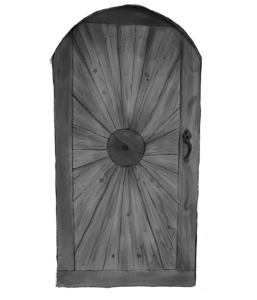
By the time we reach the opposite entry, my pulse remains steady. The door is tall and arched, made of vertical wooden planks. The wood shows grain, knots, and small cracks, giving it a rustic, hand-crafted look. A circular wooden medallion sits at the center, with the planks radiating outward in a sunburst pattern. The frame is thick, sturdy, and slightly darker than the door. On the right side, a simple curved metal handle is attached with visible fasteners. I press my palm against it, feeling the cold seep into my skin, and then push. It opens without protest.
Inside, the air changes. It smells of damp stone. We move quickly now, guided by memory and logic, descending short passages, turning where sound is least likely to travel. The detention cells lie deeper within, separated from the main barracks.
When we reach the prisoners, they look at us as if we are ghosts. Faces marked by bruises and exhaustion lift in disbelief. There are women among them, some young, some older, and a few men whose defiance has earned them the same punishment. I waste no time on speeches.
“We are to make you free. If you want to leave this place, you will have to walk and follow us exactly without making any noise. Am I clear ?”
They nod, fear sharpening their obedience. Seventeen women and four men, worn and bruised but alive, shuffle carefully, their eyes wide with disbelief and hope. After opening the cells with the keys we found on one of the three guards inside the fort, we move on. With caution, we retrace our steps and leave this place as fast as we came in. Behind us, the fort remains largely unaware of what is being taken from it. We have seen only a fraction of its guards. I sigh, we were prepared and lucky. Thank you, Yulin, for blessing us during this night. Even though you do not respond to me anymore, I will never lose trust in your judgment.
Leaving the fort by a few meters, we emerge into the night with the prisoners clustered between us. Our shields are used to form a living barrier in case danger should appear. The narrow streets welcome us back, swallowing our movement. For a moment, I allow myself to believe we are clear.
Then I feel it.
The shift in the air, the weight of intent behind me. I turn just as a stronger presence closes in, a guard faster than the others, its movements precise and probably deadly. Their eyes are fixed on me. I had stayed two meters behind the group in case something like that happened. There is no time to warn the others. No time to retreat.
I step forward, placing myself between them and the women, spear lifted into position. My pulse beats in my ears, but my mind is calm, assessing, ready. The guard emerges fully into the patch of darkness between two tall buildings. The night is heavy here, so thick that faces are hidden in shadow. I catch only glimpses of his armor: thick leather embossed with patterns, the edges of a curved sword catching the faint light. His stance is deliberate, calculated, waiting for me to make the first move.
We circle slowly. I strike first, probing, a low thrust of my spear aimed at his center of mass. They deflect with a sweeping motion of their shield, the leather groaning under the impact. Our steps echo against the stones, careful and deliberate. Every strike, every block, every parry is a negotiation of distance, strength, and timing. The dark folds around us, hiding our faces, leaving only movement and intent.
They swing their sword in a wide arc, and I twist under it, shield rising to meet the blow. The contact vibrates through my arm, and I push back, using the momentum to land a light but firm strike to their side. Again, they shift, a ghostly figure of intent and experience. My feet slide along the cobblestones. I sense their size, their strength, but also their rhythm.
Minutes pass as the dark air seems to thicken around us. Each movement is deliberate. I attack, they deflect. They press forward, I retreat. Then, a brief misstep, a pause that seems insignificant. Their stance shifts too far forward. I twist and counter, letting my spear slide against their armor.
Here is a tightened revision that stays very close to your original language and imagery while reducing repeated first-person recognition and sharpening the moment of realization:
A flicker of recognition passes through me, subtle, almost hidden. The way she steps, the shift of weight before a strike, the pivot, the way her blade moves to intercept and then redirect. It is a style I know well. My stomach tightens.
For a fraction of a heartbeat, my mind freezes. She should not be here. And yet every movement confirms it. Each step carries the same measured precision, the same balance of caution and decisiveness I have seen countless times during training.
I adjust my stance to meet her rhythm. I need to survive, need to give the others time to escape. My strikes are deliberate, my shield guiding my spear. I do not speak; there is no time. Only the clash of wood, metal, and leather.
She presses harder. Danger brushes past me as a spear is parried, a sword deflected. The street is too dark to see her face, but her movements are unmistakable. I let instinct take over, memory shaping my response.
Then I see an opening. She overextends slightly. I step in with a swift and precise thrust. My shield drives into her shoulder; I twist and force her back. She stumbles, just enough. I pivot and withdraw, then press forward again.
Every movement is calculated and aimed to subdue. My shield intercepts her blade; my spear slides along her armor, driving her steadily down. And at the moment she falters, just before I can end it, I see it clearly: the stance, the weight shift, the subtle flick of the wrist in a defensive feint.
Tariro.
The realization hits like fire, sudden and searing. Still, I do not stop. I cannot, not until the prisoners and the women are safely away. I tighten my grip, apply controlled force, and bring her down. She lies on the ground, shield askew, eyes wide with surprise, my spear hovering above her, poised for the final blow.
Only then, in the dark alley where shadows swallow us both, do I fully comprehend whom I face. Tariro, my friend, my comrade, lies beneath my spear, a testament to the dangerous paths that have led us here.
My spear still hovers above her, my breath uneven, my arm tense from holding back the final blow. The alley is narrow, choked with shadows and stone. Somewhere far away, footsteps echo. Those must be guards searching for the prisoners.
The woman beneath me shifts slightly.
“Do it,” she says. Her voice is steady, but there is a tremor beneath it. “Finish it.”
I freeze.
That voice.
I lower the spear just enough to breathe. “Tariro,” I whisper.
Her body stiffens instantly. The shield jerks upward, defensive, instinctive. “Don’t,” she snaps. “Don’t use that name. You don’t know me.”
“I do,” I answer quietly. “And you know me.”
Silence stretches between us, taut as a drawn string.
Her eyes search the dark, trying to carve my face out of shadow. “You shouldn’t know my name,” she says slowly. “And you shouldn’t fight like that.”
I take a step back and finally lower the spear fully, letting its tip touch the ground. “You hesitated on your left side,” I say. “Just like you always did when you doubted yourself. You still protect before you strike.”
Her breath catches.
“That’s impossible,” she whispers. “Xia is dead.”
The words hit harder than any blade.
“I’m not,” I say. “I disappeared. And they let you believe I was gone because it was easier that way.”
Her grip tightens on her shield. “You vanished,” she says, voice sharp now, wounded. “One night you were there, the next you weren’t. Nobody. No answers. And Gudo, “She stops herself. “No. You don’t get to say his name.”
“I have to,” I reply. “Because that night is the reason I’m here. And the reason you’re lying in front of me instead of walking away free.”
Her eyes flicker. Suspicion wars with something deeper, a memory mixed with grief and confusion.
“You disappeared the same night Gudo did,” she says carefully. “And now you come back during a raid on the fort, dressed like an enemy, fighting like a ghost. Give me one reason not to scream.”
“Because if you do,” I answer, “you’ll never understand why everything you’ve given yourself to is built on a lie.”
She lets out a short, disbelieving laugh. “Ah. There it is. The speech. The deserter’s excuse.”
“This isn’t about desertion,” I say. “It’s about truth. And about you.”
Her jaw tightens. “Don’t.”
“Tariro,” I continue softly, “why did you join The Community?”
She blinks, caught off guard. “You know why.”
“I want to hear it.”
She exhales sharply. “Because I had nothing left. Because my body failed me. Because I was cast out like something broken. Because I needed to believe that pain could be shaped into purpose.”
I nod. “And now you wear armor. You carry weapons. You enforce order.”
“I protect people,” she snaps.
“Do you?” I ask gently. “Or do you protect a system that taught you your worth depended on usefulness?”
Her mouth opens, then closes.
I press on, not accusing, just laying the question between us. “You joined because you were crushed by the world as it is. And now you are asked to be the blade that keeps it that way.”
Her voice falters. “That’s not…”
“You heal,” I interrupt softly. “You always did. Even when you thought you weren’t enough. Even when you were afraid. That hasn’t changed. But tell me, when was the last time you chose who deserved saving?”
Silence.
Then, very quietly, she asks, “Why did you disappear, Xia?”
I take a breath. This is the edge. No turning back.
“That night,” I say, “I meditated. Like I told Gudo I would. The moon answered.”
Her eyes widen despite herself. “The moon?”
“Yulin,” I say. “The spirit I never dared speak of openly.”
She stares at me, stunned. “You told Gudo.”
“Yes,” I whisper. “And he listened. More closely than I understood.”
Her face drains of color. “No,” she breathes. “Gudo wouldn’t…”
“He did,” I say. “Because Gudo isn’t just Gudo.”
I recount it slowly, carefully. The manifestation. Yulin’s descent. The name Akin. The truth of the sun. Masimba. The theft. The centuries. The hunger. I tell her how the man we laughed with spoke with another voice. How he revealed himself without shame. How he tried to consume the moon itself.
Tariro shakes her head, breath uneven. “This is madness.”
“I know,” I say. “I thought I was dying. Maybe I almost did. When the power tore through the room, I was thrown into the river. Burned. Broken. Lost. When I woke again, The Community believed I had vanished. And Gudo, Masimba, made sure no one looked too closely.”
Her eyes glisten now. “He comforted us,” she whispers. “He told us loss was part of devotion.”
My voice tightens. “Because grief keeps people obedient.”
She looks down at her hands. At the leather armor. At the weapon resting beside her.
“So this is the truth,” she murmurs. “I joined to escape cruelty… and became trained to enforce it.”
I crouch in front of her, meeting her gaze. “You don’t have to keep doing that.”
“And go where?” she asks hollowly. “There is nothing outside.”
“There is,” I say. “A village. Women who feed each other in secret. Fighters who train to protect, not dominate. People who still choose one another.”
She laughs weakly. “You make it sound simple.”
“It isn’t,” I admit. “But neither is living as someone else’s weapon.”
Footsteps echo again, closer this time.
Tariro looks up at me, fear and clarity colliding in her eyes. “If I follow you,” she says, “I betray everything I was taught.”
“If you stay,” I answer, “you betray yourself.”
She is silent for a long moment.
Then she exhales, long and shaking. “I always thought I was good for nothing,” she says softly. “Maybe that was the lie that made everything else easier.”
I offer her my hand.
“Come with me,” I say. “Not because I’m right. But because you deserve to choose.”
She stares at my hand as if it might vanish.
Then she takes it.
“Alright,” she whispers. “I’ll come.”
I pull her to her feet just as voices ring out nearby.
We disappear into the dark together. Two women once shaped by the same lie, now walking away from it, step by uncertain step.
The streets outside the fort grow quieter, a thin torch flickering weakly against the wall of a narrow alley. Shadows stretch and curl across the uneven stones, moving like restless spirits, while the pale moon offers little guidance. My heart pounds as Tariro and I guide the prisoners through the twisting streets. Each step feels laden, the weight of responsibility pressing down on me with a gravity that makes the air itself seem heavier. I sense every movement, every whispered shuffle of feet, as if the city itself watches us and judges our passage.
Then, from a side street, I perceive them. Two figures emerge almost as phantoms: Mundra and Shungu. My chest tightens, and a sharp prickle runs along my spine. Mundra’s club catches the faint torchlight and gleams, ominous and deliberate, while Shungu’s curved blade flashes just enough to twist my stomach with apprehension. They have come from another path, guarding the fort, and now they intersect with our escape.
Mundra’s voice cuts through the heavy silence, calm and measured yet bearing the weight of command. “Xia. Stop. You do not need to make this harder than it has to be.”
Shungu’s tone is different, softer, and more intimate. It makes my skin crawl with unease. “Tariro. Come back.”
I glance at Tariro. The torchlight falls unevenly upon her, casting fragmented shadows across her face, yet I perceive the unwavering determination in her eyes. She does not hesitate. She only nods to me, and I feel the reassurance settle briefly within my chest. My hand tightens around the shaft of my spear, knuckles whitening.
Mundra advances first, swinging his heavy club with the precision of one who has studied the art of war for years. I duck and roll, narrowly escaping a crushing blow that splinters the wall behind me, sending splinters into the shadows. Every strike demands a counter, a movement that draws from every sinew and joint, my muscles protesting in their own language of pain. A single miscalculation could end everything in an instant.
In the flickering torchlight, I notice Shungu’s gaze shift between Tariro and me. His movements falter, and for a fleeting heartbeat, he freezes. Surprise paints his features. He did not expect to see her flee alongside the prisoners and me. His eyes widen, the realization dawning too late, that she is not remaining behind.
I grit my teeth, forcing every fragment of my attention onto Mundra. He is formidable, stronger than I anticipated, and each parry and twist of my body draws sweat and effort from every part of me. Then, a moment opens. I feign a lunge, drive my spear against his shield until the wood cracks beneath the force, and follow with a precise slash that severs two of his fingers. Mundra roars, staggering back, the sound reverberating through the narrow street.
Before I can steady my breath, Shungu strikes from behind, his blade aimed at me. I twist at the last possible moment, sensing the rush of air as the weapon passes perilously close. My chest heaves, adrenaline and fear clawing at every thought. I glance behind me. Tariro has been pushed to her knees, Shungu’s blade perilously close, yet her posture does not waver.
Then she acts. Fluid, controlled, unwavering. She drives him back with a movement that is both calm and powerful. The torchlight glances across her eyes, igniting them with unflinching resolve. He stumbles, unprepared, caught between disbelief and the sudden understanding that she resists with a strength he did not expect, not here, not now.
“Tariro!” I shout, my voice breaking with urgency.
“I am not backing away,” she replies, steady and unyielding. “I am leaving with you.”
Shungu freezes. His chest rises and falls, the blade dipping slightly. His skill falters before her certainty. Rage, disbelief, and helplessness flicker across his face, yet he makes no further move.
I turn my attention back to Mundra, still reeling from the loss of his fingers, fury and pain etched across every line of his expression. I do not hesitate. I push past him, spear held ready, moving toward the darkened corridor where the prisoners wait, shadows swallowing our forms.
Side by side, Tariro and I run. Behind us, Mundra shouts, fury spilling into each word with a force that makes my ears ache. “This is not over! The Community will find you! You will pay for your treason!”
Shungu follows, carrying Mundra with him, and his voice is lower, almost resigned, yet clear enough for me to hear. “It is not your fight anymore. Go.”
I do not look back. The torchlight flickers just enough for me to see the shock and disbelief on Shungu’s face as he recognizes Tariro fleeing with me. My chest burns, every muscle protests, but I pay it no heed. In this moment, we are free.
Next chapter
17 - Jeopardization