Jeopardization
After we successfully freed the prisoners from the fort in Gungara, we decided to be discreet and not return to the village as a single group. That would invite questions if we are seen with the freshly rescued prisoners. Instead, we fracture ourselves carefully. Once we arrive at the edge of the fields from the village, right before the first huts appear, we pause and reorganize. The female fighters return to their houses in small groups, each taking one or two former prisoners at most for their household. On our way to the village, we discussed and quickly chose to call them relatives in case guards from Gungara should patrol around for the next few days. Some became a cousin returned from another village, others a widowed aunt. The stories are simple, ordinary, and therefore believable.
I watch them disperse through the narrow paths between huts, slipping into doorways before dawn fully breaks. Once everyone is back inside, I feel relieved. We did it. Our operation was a success. We could save those inhabitants who were jailed for protesting against the king in an act of rebellion for the unjustified murder of Nyasha.
By the time the sun rises in the village, we can feel the mood twitching through the villagers. It all starts with the men, husband or father, to the women who welcomed new guests into their home. They are puzzled by the unfamiliar figures moving around and the extra bowls at meals. They ask questions that begin softly and grow sharper with each answer that does not quite satisfy. Where did this person come from? Why has no one mentioned them before? How is it that so many relatives appear at once? At first, the women deflect, but deflection soon becomes explanation, and explanation transforms into confession.
By midday, the truth spreads faster than a whisper. Everyone knows what happened during the night, but they can hardly believe it. They learn that some women have been leaving their homes in secret after dark. That shields and spears have been hidden beneath grain sacks and sleeping mats. That training has taken place beyond the fields, under the cover of trees and silence. They learn about the fort, about the prisoners, about the risks taken without their consent or knowledge. Some react with anger, others with fear, a few are simply stunned, struggling to reconcile the familiar faces of wives and daughters with the idea of them moving as fighters in the dark. The village trembles with incomprehension.
Chipiri is the one who steps into that space before it fractures. He does not raise his voice, nor does he accuse or defend. He listens first, letting complaints exhaust themselves against his calm. In this village, people have learned to trust him for a long time. He has always carried himself as someone who sees the whole rather than the part. And when he speaks, he does so as Nyore’s son, as a man shaped by a woman who has never confused authority with domination.
While helping in one of the fields, I watch Chipiri doing his best to calm the people. By the time the sun begins to tilt westward, the shouting dulls into uneasy silence. Nothing is resolved, but the ground holds. Chipiri has managed to calm the voices because they put their faith in him. He engages himself in speaking with Nyore and me and finds a solution once the whole situation is clearer. I smile. I wonder how he will find his way by speaking to his mother. Nyore has a strong will, that is for sure.
Once my work in the field is done, I come back inside Nyore’s hut. The air smells of onions and crushed herbs. Tariro stands in the left corner, cutting vegetables with careful attention. I join them cheerfully, happy to find my friend back after all this time. I was working without her this afternoon because she needed to rest longer than me. The changes in her life have been abrupt: living in a new place, new people around, only knowing me, and abandoning her old, nasty home, which we both call The Community. Most of all, I want her to feel comfortable in this new place. Preparing the meal, we speak of small things and enjoy each other’s company. The fire crackles softly between us.
One hour of preparation later, the meal is almost ready as the marvelous scent dances around us. We prepared a thick maize porridge served alongside tender local greens. It is lightly flavored with aromatic herbs and onions for taste. This is how Tariro and I like it, and I am not worried about Nyore’s taste. Suddenly, the woven door curtain shifts as someone steps inside the hut. Chipiri is here, his expression tired, his presence filling the space without a word.
He does not speak immediately. He simply stands near the entrance of the hut, arms crossed, eyes moving from the fire to Tariro, then to me, then finally resting on his mother, Nyore, who was resting while we were cooking. The crackle of burning wood fills the space between us, stretching the silence until it feels deliberate rather than awkward.
Soon, Chipiri raises his voice, “When I walked in, I expected to hear explanations, not silence.”
Nyore does not look away from the pot she is stirring. Her movements are slow, grounded, “Anger does not feed anyone,” she replies. “Sit, Chipiri.”
He does not and answers instead, “Women have been training in secret. Prisoners have been taken out of the fort of Gungara. You know guards will come. Do you understand the danger you have placed on this village?”
I feel the weight of his words settle against my ribs. He is not completely wrong, but we had to do something, and I regret nothing. Action was needed for Nyasha’s sake. Fear sharpens Chipiri’s as I reply to him, “We know all of that. We did not act without considering the cost.”
“That is easy to say now that it’s done,” he answers sharply, turning his gaze on me.
“Enough,” Nyore says, almost cutting Chipiri’s last sentence. “This was necessary.”
Chipiri exhales through his nose, frustration tightening his jaw. “Then tell me, Mother. Tell me how this was necessary.”
Nyore changes her posture to be more comfortable before reacting with the patience of someone who has been watching a collapse for far longer than anyone else. “Tell me, my son. For how long have you pretended not to see what is happening around us?”
He stiffens. “I see plenty.”
“Do you?” She asks quietly. “Every day the river grows bitter while the fish die closer to the surface. The watermills the king ordered to build in the river around Gungara affect the water and make those fish leave. And what about those lands that dry up during the night from one day to another without any explanation? Except for Tonderai’s fields, one of the Advisors of the king, whose fields remain as green as ever… We will not survive for long if all of this continues, and you know it better than anyone else. Are you not the one who wanders between all the surrounding villages and told me how bad all of this was? How would we seriously lack food and resources in one year or two if nothing changes?”
Chipiri looks away, uncertainty and anxiety spread along his face,
“What can we do? Does sneaking into Gungara most powerful military place after the king’s house, will change all of this?”
“This is still better than restless obedience until we can no longer survive,” Nyore replies.
Chipiri’s voice lowers. “Even if you are right, this path leads to blood. Would you risk our lives for a chance to change all of this? Even if we succeed, how many of us will have the chance to enjoy a new life while grieving the death of our friends and family?”
“Far enough,” Nyore retorts simply. “We will face many losses for sure. But so will standing still. At least this path leads us to some hope.”
As Chipiri no longer knows how to keep up with his mother’s sturdiness, he looks at me, his eyes searching my face, as if weighing the truth of me, “What about you, Xia? From what I heard, you are the one who taught these women how to fight and lead yesterday’s night operation.”
“I did,” I tell him truthfully.
He shakes his head. “And you would do it again?”
I do not hesitate for long.
“I would.”
Chipiri frowns, “Explain it to me then. Do you really think this is the path we should follow?”
Mustering my courage, I affirm my position to him, my words straight and sincere,
“Don’t you see that all those people who believe in you are slowly dying with all those problems? Will you accept watching them suffer without trying anything? You can if you want, but I will not. Even if I wasn’t born in this place, the kindness and efforts of the people living there have touched me.”
Silence follows. Not resistance, not anger. Consideration.
Chipiri sinks onto the low stool near the fire, elbows resting on his knees. The weight he carries finally shows in the slump of his shoulders.
“I fear to risk their lives,” he says quietly.
“So do we all, but enduring things like this without any change is only delaying our worst outcome,” Nyore replies.
He looks up at her, then at me, then at Tariro. Something shifts in his eyes, subtle but irreversible. “Let’s hope that even if we fail, we will be loud, loud enough to stir courage in the hearts of many inhabitants. We are not the only ones to suffer, I know this very well.”
“You’re right. If we act, people will not forget about it,” I mutter, smiling.
He nods once and exhales his final words of approval with a mix of pain and relief, “Then I stand with you.”
This evening, from the moment Chipiri leaves the hut, the village begins to change more than it ever has. The next morning, he wanders everywhere and speaks to the people in the fields, near the wells, or along footpaths worn smooth by generations. At first, people are unsure, and some even avoid him. Fear seems to answer before hope can. But Chipiri keeps his mind up and returns again and again. He is patient and unyielding. Soon, some villagers start to consider the idea of a rebellion. Some think Nyasha. Some about the growing hunger. Some remember how impressed they felt when they discovered how women had learned to fight in a few nights with a discipline they had never been taught. If those women they knew could learn and succeed, then perhaps the rest of the village could too. Within a week, Chipiri has convinced enough people, and I can begin the night trainings again. We remain cautious in case guards from Gungara come, but we act nonetheless, training with the night. Every evening, one or two men join us with hesitant but determined looks. Other women who had not dared to join us before changed their minds. Spears are passed from hand to hand as more people learn the basics of fighting. Hopefully, I am no longer the only one teaching. Tariro steps into that role with a quiet authority. Others follow. I chose them personally. They are the best fighting women from the operation in the fort. It has to be this way, with so many to teach, I could not hold them all alone.
We are well organized. In case any guards come patrolling to the village, we are alerted in time by the fishermen who work near Gungara. Actually, guards came twice already. And thanks to the fishermen’s early call, we were easily able to hide every weapon and traces of the training area.
Another week later, word of our training spreads beyond the village between truthful friends and family. Nearby villages listen with curiosity and disbelief. Some join us, so we sent other quick learners to teach them the basics. At times, Tariro and I would even walk to these villages and give more precise instructions so they can improve faster and adapt their fighting techniques. We soon needed new spears and shields, but Tariro knew other warehouses I did not know. In three days, we were able to steal them without anyone noticing. Those were for urgent situations. In apparent peaceful times, no one would found out that half the stock was missing.
Time followed as all of this continued smoothly. Meanwhile, I continued to meditate and connect to the spirit of the moon Yulin, but she never gave me any clear response. I could only accept it and move forward.
One month has passed, and we are now close to the day when we will all take action and head to Gungara with our weapons and strong spirits, hoping change the Kingdom of Zimori. One week remains before the night we have chosen. One week before the villages turn toward Gungara, not as subjects, but as people who have decided to live.
I sigh and try to rest the best I can. Tonight is meant to be mine. Nyore and Tariro are outside the village, their silhouettes moving between torches as voices rise and fall in disciplined rhythm. Tariro is teaching while Nyore observes from her old age. Chipiri also went with them, not to command but to learn with the others. Their brief absence leaves Nyore’s hut unusually still. The fire has almost collapsed into embers, and the clay walls retain the day’s warmth like a held breath. I sit on the mat with my back against the wall, eyes closed, palms resting on my knees. This is meant to be a resting night. I repeat that thought as if repetition alone could make it true. My body aches in familiar places. I let the sensation pass through me without resistance, until thirst pulls me back to the present with an insistence I cannot ignore.
I take a spear, and I stand. I try to keep a weapon on me at all times, we never know what could happen. I stand outside and walk to fill a jar with fresh water. The well lies near the forest edge, where the village thins and trees begin to swallow sound. I walk the path without thought, bare feet brushing dust and roots, moonlight breaking through the canopy in scattered silver fragments. The jar dips into the well with a muted splash.
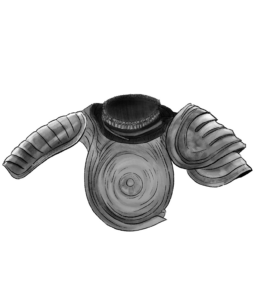
Suddenly, I hear unusual sounds. I turn my head with wariness and try to see what it could be. Three figures detach themselves from the trees. They move without haste, disciplined and deliberate. Their leather armor absorbs the light as their tall oval shields rise in unison. But this is not what worries me the most. I watch more closely at their spears that point directly at my chest… They do not speak and simply come at me together in silence. One second later, they attack. I raise my spear just in time as the first strike skids along the shaft, the vibration running painfully through my arms. A second thrust follows immediately, aimed low. I twist aside and feel steel graze my thigh, hot and sharp. I counter with the butt of my spear, driving it forward with my full weight. It slams into a shield. Its surface absorbs the impact with a dull, unyielding sound.
They press in, coordinated, relentless. One attacks high, one low, one waits, measuring. Their footwork is precise, economical, shaped by years of shared drills. No movement is wasted. My breath shortens as understanding settles into place with cold clarity. The Community. I know this way of fighting, this way of moving. I lived and fought with those men… Not having any more time to understand, I strike again, aiming for the shoulder of the nearest assassin. The spearhead glances off the rim of a shield and slides away. A club crashes into my forearm. I should have expected this… Indeed, The Community has many more weapons than just spears. Pain blooms inside me with a strong and sudden feeling. I barely keep my grip. I retreat instinctively toward the trees, but another blow lands against my ribs. Something inside me protests sharply.
Trying to think to the risk I or the people around might encounter, I come to a decision. I do not want these assassins, probably senior from the Blades, anywhere near the village. Reacting accordingly, I turn to face the dark of the forest and run as fast as I can. Branches whip my face as I plunge farther into the forest. Roots catch at my feet. The ground slopes unevenly, familiar in ways that save me seconds. I know where the earth dips, where moss hides stone, where fallen trunks wait to trip the unwary. I have lived around here for months. This is an advantage I must use against my opponents. Unsurprisingly, they follow. I can hear them behind me, shields brushing leaves, breath controlled, footsteps measured. They do not shout, nor do they rush. They know I cannot run forever.
I pivot suddenly, planting one foot against a rock and swinging around. My spear lashes out in a wide arc. It strikes a shield again, numbing my hands. A spear answers immediately, driving into my shoulder. The blade bites shallow, tearing muscle before withdrawing. I stagger back with a cry I swallow before it escapes. I strike blindly now, desperation shaping my movements. I land a shallow cut across an arm. The assassin barely reacts. A shield slams into my chest, and I fall hard, breath exploding from my lungs. They surround me, patient and contained. Even with just a spear, I could win against one, but three is too much for me. The third assassin moves one step forward as moonlight slides across his face for a fraction of a second. This is Mundra, the one who helped me so many times, the one who guided Tariro and I for our first missions. The recognition hits harder than the blow that follows. His club crashes into my leg. Bone screams as I clamp my jaw shut until it aches.
There is no space for questions. I roll aside as a spear drives into the ground where my head was moments before. I scramble up, using a tree trunk for balance. Blood runs warm down my thigh. My left arm trembles, fingers stiff and slow. I strike again, not to harm but to create space, aiming for shields, spear shafts, and armor edges. I feel blows land on my back, my side, my arm. Each one steals something I cannot spare. My vision blurs at the edges, but still I turn around once again and run in one last desperate hope.
My legs feel heavy now, sluggish. Each step sends fire up my spine, some branches tear a bit at my skin, while thorns are caught in my hair. I push through regardless, lungs burning. I continue to run, forcing my legs to obey. My body shakes uncontrollably. Blood soaks my clothes. I know they will find me. But thanks to the fact that I know the forest better than they do and my gloomy adrenaline, I managed to win some time, not much, thirty seconds I would say. I look up at the moon through the canopy, blurred and trembling. I am certain that I cannot move anymore. The fact that I am still standing up is already remarkable. Then, one last idea comes to my mind. Despite the pain, despite the blood, I press my palms together and breathe as smoothly as I can. I want to meditate for Yulin. One last time, I want to connect with this shining spirit of the moon.
I sink fully into the forest floor. Leaves damp beneath my feet as blood cools against my skin. Every breath is sharp. Each inhale trembles with the pain that burns through my muscles. I fold myself inward and close my eyes, drawing the darkness close as if it were a cocoon.
I whisper the meditation my mind and my souls knows so well,
“Moon raises, mind praises.
They are the peak of our dreams, yet they protect.
They are the limits of our streams, yet they connect.
Yulin, beauty of white, shining of light.
Reach your devotee and show them the way,
for they truly wish to reach the bay.”
I hear nor sense nothing except for the feet of the assassin getting closer by the second.
Not paying attention to them, I speak again, louder this time.
“Yulin, I have tried. I have done everything I could understand and feel from you. I have walked the path you showed me as best as I could.
I was so happy when you took a breathtaking human form to speak with me. Sadly, Masimba deceived me and hid behind the name of Gudo. I did not see it, nor did I know about Masimba. How could I know that someone had entrapped the spirit of the sun inside him to live for so long? I don’t know… But I know that I have failed you nonetheless… Even though I feel childish, I want to thank you one last time and excuse myself to you. Please, forgive me…
I want you to know that I am truly grateful to you, Yulin. Grateful for the life you allowed me to live. Can you feel my gratitude? Even if you do not answer me, even if you remain silent, I need you to know all of this.
Even today, even now, I would not trade this life, no matter how it ends. Connecting with you was truly something to live for. Thank you, Yulin.”
I close my eyes again, letting the moon’s pale light brush my skin.
The silence stretches, deliberate and complete. I am content with it. I am ready to fade into it. Then I hear it, the closer faint stirring of leaves, a whisper that grows into movement too deliberate to be natural. My eyes open slowly, heart tightening, blood still warm on my skin. They have arrived. The three assassins, emerging from shadow as if conjured by my own fear, weapons glinting, silhouettes sharp against the moonlight. Mundra, among them, is calm and patient. There is no room for negotiation. There is no time for hesitation. They will kill me, here and now.
Finally, I utter my final words,
“Yulin, thank you for letting me see your energy, for letting me feel how it surrounds each and every one of us. Even if your voice remains hidden, even if your reply will not come, I do not regret. I am glad I lived as your devotee.”
All of a sudden, the forest stills as blue light flashes before my eyes, searing, brilliant, alive. I see nothing else, feel nothing else. The forest, the assassins, the cold, or the blood all vanish behind that single, impeccable brilliance. I do not understand. I do not question. I only let it fill me, let it swallow everything.
Next chapter
18 - Reconnection