Echoes of the Past
Card Game
In Akin Legends: Echoes of the Past, embody the memories of a vanished world, awakened after 1,000 years of silence. Explore the ruins of ancient kingdoms, summon the spirits that once guided mankind, and piece together the fragments of the past. As long as Akin remembers, the ancient world still breathes… and the sun can finally rise again.
Contents
A rulebook & printable cards (PDF)
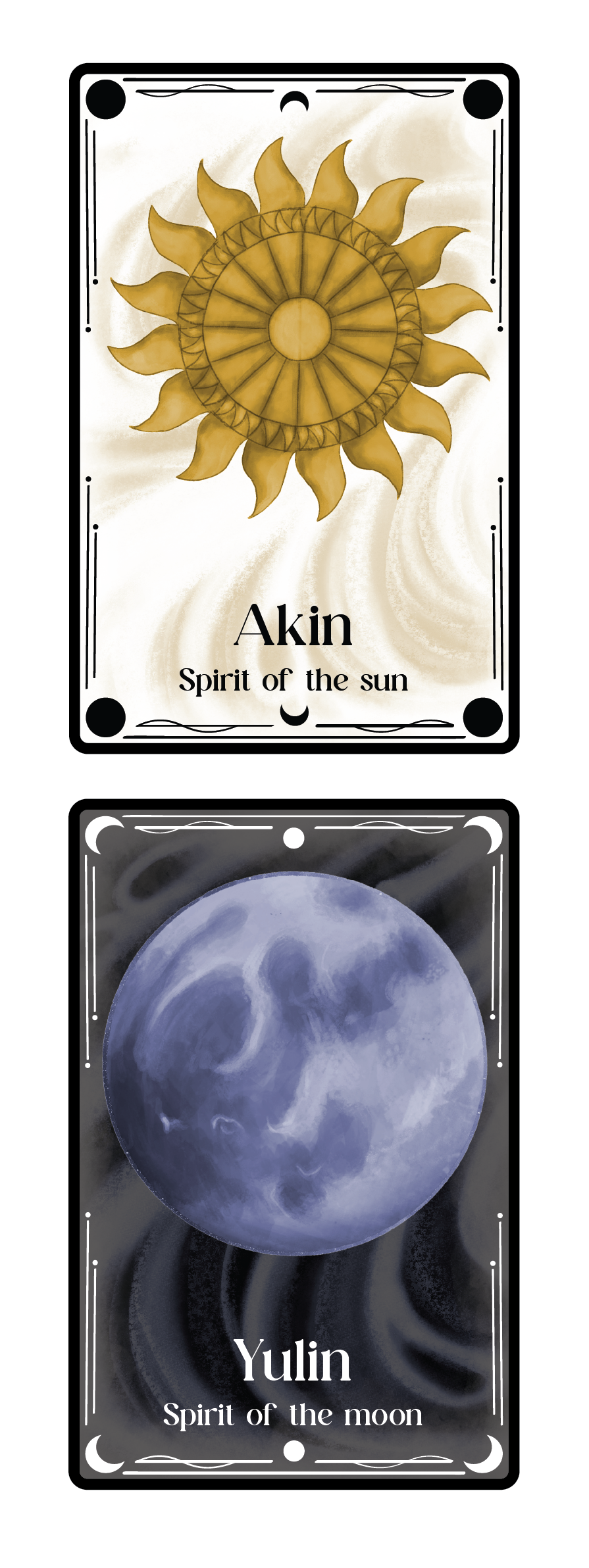
- 1 Akin card
- 1 Yulin card
- 4 turn counter cards
- 6 protector cards
- 12 defense cards
- 81 summoning cards
Game Rules
Print and cut all components included in the downloadable PDF before starting the game.
Objective
In Akin Legends, players form teams of two and compete to win the favor of the spirit controlled by the opposing team.
To do so, they must break through their opponents’ defenses while protecting their own.
Setup
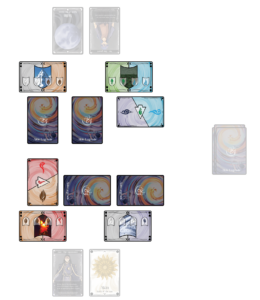
Players form two teams of two facing each other around a table. Each team takes either the Akin card or the Yulin card; this is the card that team will have to protect. Next, each team draws one Protector card and three Defense cards, which they place in front of them.
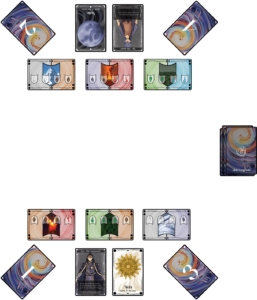
The Turn Counter cards, numbered 1 through 4, are then distributed so that two players from the same team do not play one after the other. Finally, the Summoning card deck is shuffled, and each player draws 7 cards.
Card Types
Akin & Yulin
These are cards indicating the teams and serve a primarily decorative purpose.
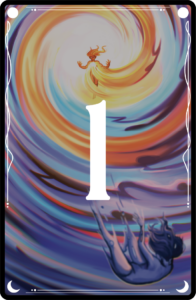
The counter cards
They help players remember the direction of play.
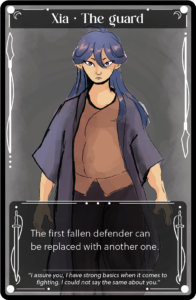
The "protector" cards
The “protector” cards are unique cards that grant each team an active effect throughout the game
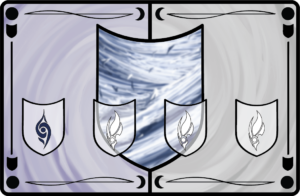
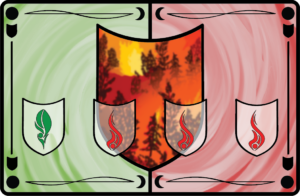
The “defense” cards
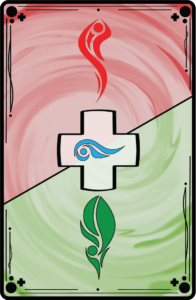
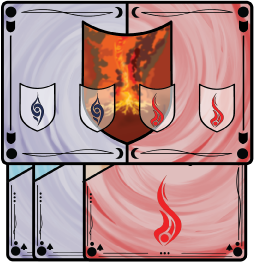
These are the cards representing the defenses each team must defeat to reach the opposing spirit. These defense cards consist of two different elements that players must combine to destroy them.
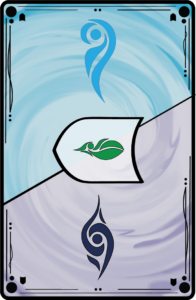
The “summoning” cards
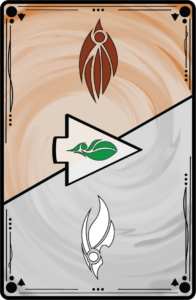
These are the main cards of the game; the ones players will draw and play. Summoning cards have three components: 2 attacks and 1 special effect. The orientation in which the player plays the card indicates which component they intend to use this turn. Attacks are used by placing the card vertically, with the element of the desired attack facing the opponents. If the attack succeeds, the player will then place this card under the targeted opponent’s defense card, leaving only the element used visible to indicate which elements have already been applied to the defense. Special effects are played by placing the card horizontally. There are 3 types of effects:
Defense
The defense effect allows you to counter an attack of the same element. If multiple cards attack with the same element, the defense card will stop only one and let the others through.
Healing
The healing effect allows you to remove a matching element already applied to one of the team’s defenses from a previous turn.
Boost
The boost effect only takes effect during the confrontation phase; during this phase, all cards attacking with the same element as the boost card deal +1 damage. So, a fire attack counts as two fire attacks, and so on. This effect applies to the entire team and is stackable. Once the confrontation is resolved, this effect is removed, and the number of elements applied to the opposing defenses cannot exceed the number of attack cards played
How to play?
1. Playing cards
The player who starts is the one with the turn counter card marked 1; next is the player with card 2, then 3, then 4. Then comes the second turn of the round, which starts again at 1. During a round of play, each player takes two turns. On the first turn, everyone plays normally. On the second turn, players play their cards face down. Players may not tell or show what they are playing, either to their opponents or to their teammates. However, the orientation of the cards must be respected; this is the only way for other players to get a clue as to what the player might be playing an attack or a special effect.
The player who starts is the one with the turn counter card marked 1; next is the player with card 2, then 3, then 4. On their turn, a player may perform two different actions: draw cards or play a card. If they decide to draw cards, that player skips their turn and discards three cards to draw three new ones. If they decide to play a card, they place it face up in front of them.
2. The Showdown
Once all players have taken their two turns, the game moves to the confrontation phase, during which all face-down cards are flipped over and the effects of all cards are applied.
The first effects to be applied are always healing effects, followed by boosts, then attacks and defenses. For clarity, cards that cancel each other out (such as an attack and a defense of the same element) or cards that have no effect (such as a boost that does not boost any corresponding attack) are gradually removed.
3. Apply the elements
Once all effects have been resolved, the remaining attack elements are applied, at the attacking team’s discretion, to the various opposing defenses. If one of the defenses has all the necessary elements attached, it is destroyed and removed from the game.
4. End of the round
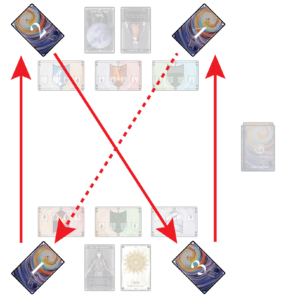
Players remove all remaining summoning cards from the playing field and pass the turn counter cards so that Player 1 gives their card to Player 2, Player 2 to Player 3, and so on. (1 → 2, 2 → 3, 3 → 4, 4 → 1)
5. Victory!
If a team manages to take down all of the opposing team’s defenses, they win the game.
Two players variant
The game is played the same way, except for the following changes: The “Spy” protector card is removed from the game. Players have two defenses instead of three. Players may draw a card each time they play a card. Players play 3 cards each round: the first face-up and the next two facedown